
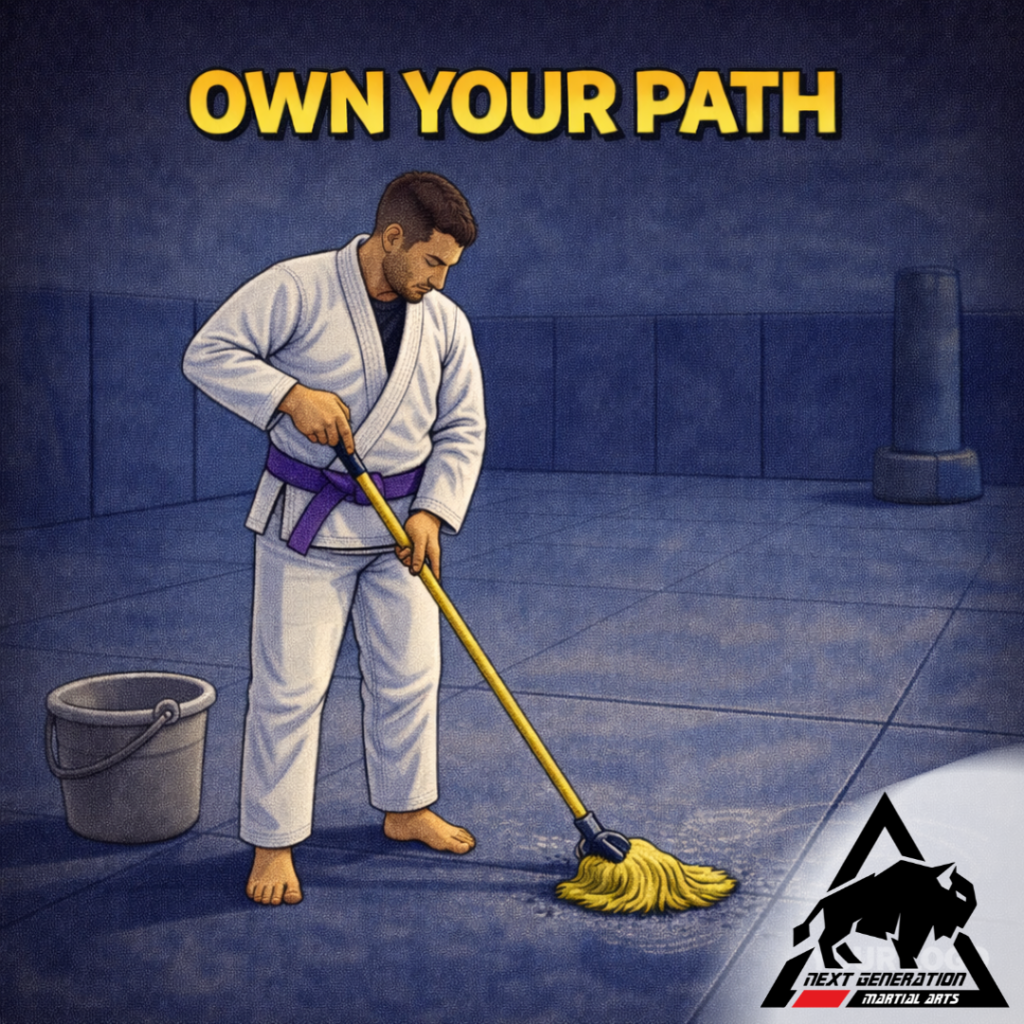
Ownership and Personal Responsibility
There is a moment in training when progress stops coming from instruction alone and begins to come from ownership. This is the point where students stop asking for answers and start searching for them. Not because they no longer need guidance, but because they are learning how to carry responsibility for their own development.
This shift changes everything.
What Ownership Looks Like on the Mat
Students who take ownership get quieter. They listen more. They try to solve problems before asking for help. When they do ask questions, they are better questions—shaped by effort and attention rather than dependence.
Ownership shows up in simple ways. Arriving on time. Staying engaged. Training with focus. When someone is late, they still show up to get whatever time they can. The work matters more than appearances.
At this stage, the instructor’s role begins to change. Coaching becomes guidance instead of direction. The student is no longer waiting to be told what to do at every step—they are learning how to navigate on their own.
Why Avoiding Responsibility Holds People Back
Many students struggle here because they believe the answers always live in technique. They ask everyone for advice without slowing down to understand why a position works. This creates reliance instead of growth.
Avoiding responsibility feels easier because it shifts the burden elsewhere. But it also stops personal development. Progress requires change, and change only happens when students look inward and ask honest questions: What about me is limiting this? How do I need to adapt?
Ownership begins when those questions are taken seriously.
The Role of the Coach—and the Role of the Student
A coach’s responsibility is to guide the path and keep students from straying too far. A student’s responsibility is to walk it.
Early on, students often confuse the two. They want answers instead of guidance because they don’t yet see the path clearly. Over time, ownership teaches them to trust the process and themselves. The coach cannot want progress more than the student does. This is a personal journey.
Failure Becomes a Tool
Students who take ownership develop a healthier relationship with failure. Failure stops being something to avoid and becomes something to learn from. Each mistake offers information. Each difficult round reveals something that can be improved.
This honesty builds accountability. It’s uncomfortable at first, but it’s also freeing. Taking responsibility is part of becoming an adult—not just in training, but in life.
Ownership Shapes the Long-Term Path
Ownership is a skill in itself. Being a martial artist is more than learning techniques—it’s walking a path of self-development. Everyone’s journey is different, and few people outside that journey will ever fully understand the effort it required.
Students who take ownership progress longer and farther. They focus on the right kind of growth. Over time, they adapt, mature, and often become leaders within the room.
This is your path. Own it.
Sign up for Jiu Jitsu in Thibodaux