
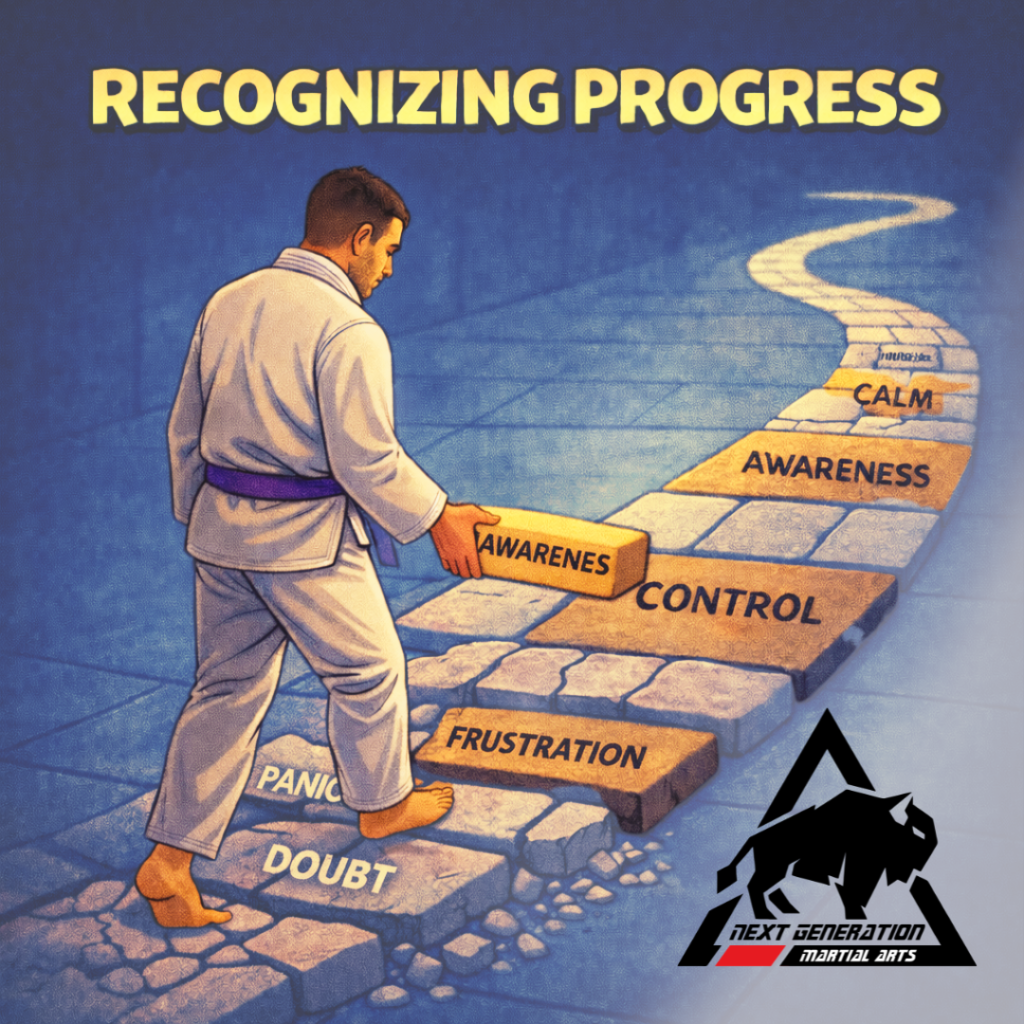
Recognizing Progress in Jiu Jitsu That You Can’t Feel Yet
For many adult students, the hardest part of training is not the physical effort—it’s learning how to recognize progress correctly. By the time consistency has settled in and the early anxiety begins to fade, many students start asking a quiet question: Am I actually getting better?
Most of the time, the answer is yes. They just don’t know where to look yet.
Progress Often Shows Up as Calm Before Confidence
In the early months of training, progress doesn’t have a specific look. It has a specific feel. One of the first real changes coaches notice is the ability to relax. Students begin to move with less tension, breathe more consistently, and stay present longer in uncomfortable situations.
That sense of calm is not accidental. It’s progress.
Being more relaxed on the mat allows students to process what’s happening instead of reacting emotionally. This is often the first real shift, even though it rarely looks impressive from the outside.
Why Comparing Yourself to Others Can Be Misleading
Many students measure progress by comparing themselves to training partners. While comparison isn’t entirely wrong, it’s often misguiding. Everyone starts from a different place, with different physical attributes, experiences, and learning speeds.
The most accurate comparison is not against someone else—it’s against who you were on day one. How would you handle the same positions now? How do you respond emotionally compared to when you started? These questions reveal real progress far more honestly than wins or losses ever could.
Awareness Comes Before Technique
Before technique can be applied effectively, awareness must develop. Early on, students rely heavily on conscious thought. Over time, awareness sharpens and reliance on feel increases. Techniques begin to surface instinctively, without deliberate effort.
This transition often goes unnoticed by the student experiencing it. Yet it’s one of the most important stages of development. Awareness allows students to stay composed, recognize danger earlier, and make better decisions under pressure.
Response Matters More Than Outcome
At this stage, outcome matters far less than response. Coaches pay close attention to how students handle both success and difficulty. Are they emotionally steady? Do they stay engaged even when things don’t go their way?
Students who are progressing internally become less concerned with winning or losing during training. Their demeanor stays consistent throughout the session. This emotional control is a strong indicator that real development is taking place.
How This Shapes Long-Term Success
Learning to recognize small wins prepares students to understand promotions later on. Real success is not the result of one big breakthrough—it’s the accumulation of countless small improvements over time. When students miss these signs, they often develop a false sense of direction, which can lead to misplaced confidence or unnecessary doubt.
Those who learn to see progress clearly stay grounded, patient, and invested in the long game.
This is your path. Walk with self-belief.
Click Here to Start Walking Your Path
Next Generation Martial Arts in Thibodaux